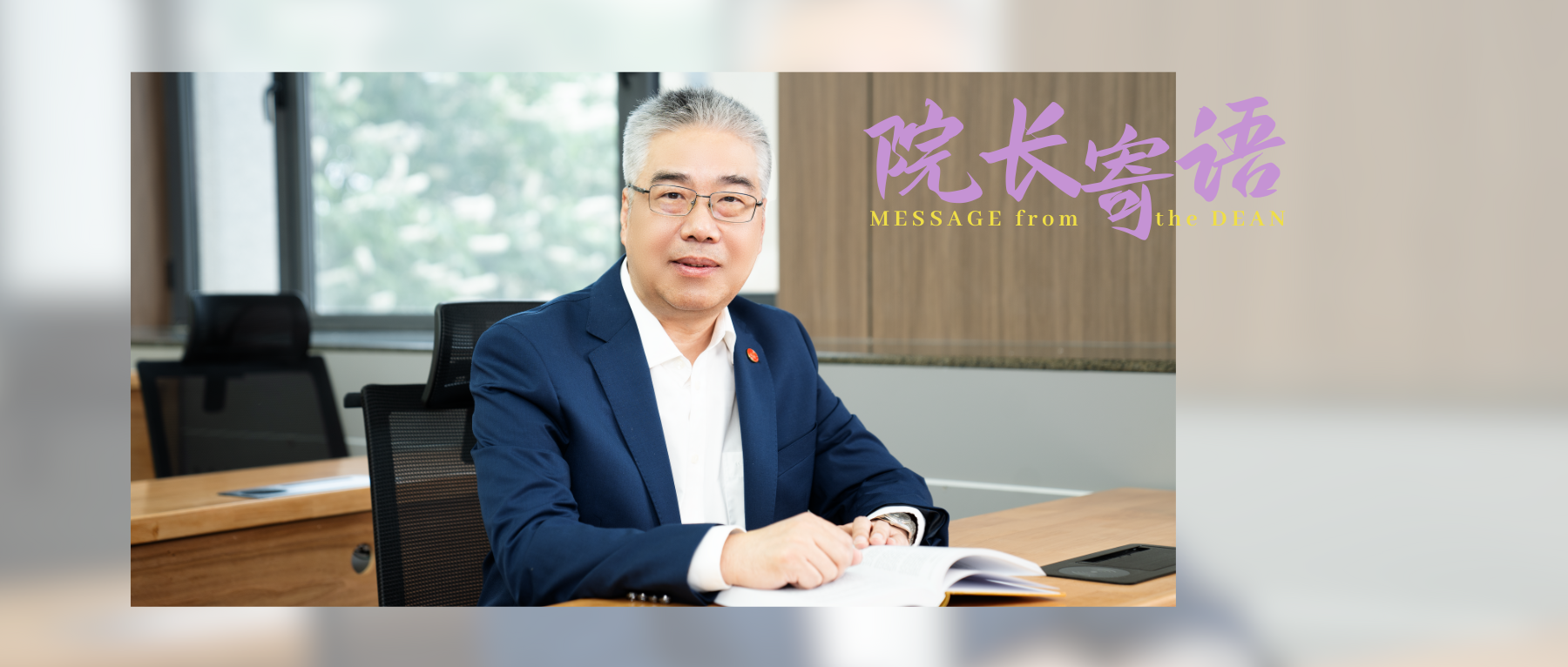
Value, Responsibility, and Humanity: A Message to the Class of 2026, School of Management, Shandong University
This message is dedicated to the graduating Class of 2026. Graduation marks one of the most significant milestones in life. Years spent on campus are much like learning to swim in a pool: here, you have built solid theoretical foundations, sharpened your analytical thinking, and mastered professional knowledge and managerial tools. Leaving the university, however, means stepping into the vast rivers and oceans of society. The journey ahead will bring both unexpected opportunities and inevitable challenges, allowing you to experience life in all its complexity. Herbert A. Simon, Nobel Laureate in Economics, Turing Award recipient, and former professor of psychology at Carnegie Mellon University, famously observed that "management is decision-making." Throughout our lives, we are required to make countless decisions. The ability to make sound decisions should therefore become one of the most fundamental competencies of every graduate of our School.
Every decision consists of two essential elements: an objective function and a set of constraints. In defining the objective function of our decisions, value should always come first. After graduation, you will work with supervisors, colleagues, clients, and partners. Human relationships in professional life are far more complex than those you have experienced with teachers and classmates on campus. When faced with setbacks, resist the temptation to blame society, complain about unfairness, or believe your talents have gone unrecognized. Instead, first ask yourself: What value can I create for my country, my organization, my family, and my friends? Value is measured not by what we know or what we are capable of, but by the tangible contributions we make in solving real problems. Those who help address the nation's development challenges become the talent society truly needs. Those who solve critical business problems become indispensable organizational leaders. Those who resolve conflicts within their families earn lasting respect. Those who stand by friends in difficult times build enduring friendships. From a management perspective, the affection, trust, admiration, or even conflict that exists between people is shaped largely by the tangible and intangible, economic and non-economic value they create, as well as the values they hold.
The world is increasingly uncertain, making a clear and steadfast value system more important than ever. Our values provide the foundation for defining our own unique contributions to society. Artificial intelligence can generate and promote countless value judgments, easily influencing public perception. Yet regardless of how rapidly technology evolves, human nature remains remarkably constant. As the ancient Chinese philosopher Guan Zhong observed, "To understand the present, study the past; to foresee the future, examine history." We should immerse ourselves in the enduring classics that have withstood the test of time, strengthen our confidence in our cultural heritage, draw wisdom from China's outstanding traditional culture, and reinterpret that wisdom creatively to meet the needs of our own era.
If value defines the objective of our decisions, then responsibility defines their constraints. Management is, fundamentally, a discipline of responsibility. Every decision we make affects individuals, families, organizations, and society. Without a strong sense of responsibility, one cannot become an effective manager, let alone a true leader. There is nothing wrong with pursuing personal aspirations, but every individual is both an independent person and a member of society. Our responsibilities to our country, our organizations, our families, and those around us must always serve as the starting point for decision-making. Authority and responsibility are inseparable. Because decision-making is ultimately the exercise of choice, responsibility must always precede the exercise of that choice. Whenever our capabilities fall short of the responsibilities involved, we should refrain from making decisions beyond our capacity.
The faster artificial intelligence develops, the greater society's need for people who are willing to shoulder responsibility. AI may assist us in processing information and supporting decisions, but it can never assume responsibility for the consequences of those decisions.
The emergence of new productive forces driven by technological innovation will inevitably reshape social and organizational relationships. At the heart of these new relationships lies responsibility—the allocation of rights, obligations, and accountability among individuals, organizations, and AI systems. As you enter society, seek opportunities to engage with people from different backgrounds, stay curious about emerging technologies, and step confidently into unfamiliar fields. Only through continuous practice can you truly understand who you are, identify the roles best suited to your strengths, and determine the responsibilities you are capable of carrying. Unrealistic ambitions divorced from one's abilities and unwilling to accept responsibility can sometimes be more harmful than having no ambitions at all.
What fundamentally distinguishes human beings from machines—and from artificial intelligence—is precisely our imperfection and our bounded rationality. These limitations are not weaknesses; they are what make us uniquely human and give rise to the richness of our humanity. Herbert A. Simon received the Nobel Prize in part for his theory of bounded rationality. If value defines our objectives and responsibility defines our constraints, then we also need a third element that helps balance the two. I call this humanity—the compassion, loyalty, integrity, and genuine care that bind people together. Only decisions guided by humanity, alongside value and responsibility, can remain grounded in reality rather than becoming detached, mechanical, or purely theoretical.
A line from Dear You, a Chinese film: " One must uphold loyalty and kindness; keep away from those with no conscience." I would like to leave these words with each of you. Today, it is increasingly easy to become confined within digital echo chambers created by AI-driven algorithms. Against this backdrop, genuine human relationships have become more precious than ever. Chinese history and literature offer many illustrations of this truth. In Romance of the Three Kingdoms, the warlord Cao Cao was renowned for valuing talent. During the Battle of Changban, he ordered his soldiers not to shoot arrows at the courageous general Zhao Yun out of admiration for his abilities. Likewise, when Guan Yu journeyed across the country in search of his sworn brother Liu Bei, Cao Cao repeatedly allowed him safe passage despite having every opportunity to stop him. Yet Lü Bu, although unmatched in martial prowess, was ultimately executed by Cao Cao because his repeated betrayals convinced Cao Cao that extraordinary talent without loyalty or integrity poses the greatest danger.
This is also why we have established the vision of becoming a business school with the deepest cultural understanding, the strongest sense of responsibility, and the greatest commitment to humanity.
By understanding culture, we clarify our values and our sense of purpose. By embracing responsibility, we recognize both the roles we are called to play and the capabilities we must cultivate. By cherishing humanity, we build lasting friendships and discover genuine fulfillment in life. May each of you make wiser, more mature, and more meaningful decisions throughout your journey ahead.
After today's commencement ceremony, you will no longer be students of the School of Management—you will become alumni of Shandong University. Wherever you are, Shandong University is with you. When we are together, we illuminate one another; when we go our separate ways, may each of us become a light wherever we are. And may you always find your way back to your alma mater.
